

Best Steel Truss Welding Production Line: A Complete Selection Guide
2026-08-30
Most steel truss welding line failures aren’t caused by bad welding—they’re caused by buying a line that doesn’t fit the actual production reality. That’s the hard lesson behind every ‘best’ list you’ll find. YI ZHOU TECHNOLOGY has spent years debugging these systems on real shop floors, and we’ve distilled that experience into this selection guide. Whether you’re replacing a manual setup or expanding capacity, the next ten minutes will help you ask the right questions before a sales rep asks for your purchase order.
Where Steel Truss Welding Lines Tend to Disappoint on the Floor
On the shop floor, the first letdown often comes from mismatched joint preparation. A truss that looks perfect in the 3D model can arrive with slightly uneven cope cuts or bevel angles that were never adjusted for actual steel thickness. Welders end up fighting the fit-up, forcing gaps closed or burning through thin edges just to keep the line moving. What should have been a clean, single-pass joint becomes a patchwork of starts, stops, and grind marks that erode both strength and trust in the drawing package.
Another quiet failure point is the overreliance on downhand welding for every connection. Floor supervisors sometimes push all truss chords and webs into the flat position to speed up production, ignoring the fact that certain joints would hold up far better with a vertical-up or overhead pass. The result is a weld line that looks acceptable on the surface but hides lack of fusion at the root, especially where the web intersects a thick bottom chord. Over time, these hidden defects translate into cracked paint, rust bleeding from the joint, and costly repairs long after the truss has left the building.
Heat management rarely gets the attention it deserves until a truss comes back from galvanizing with a visible twist. Continuous welding along one side of a bottom chord while the opposite side cools unevenly can pull the entire assembly out of plane by a quarter inch or more. Welders who chase speed forget that a truss is a dynamic frame during fabrication—every bead adds stress. Without a back-step sequence or an alternating weld pattern, the floor gets a truss that meets the dimensional tolerance on paper but fights the erector on site, forcing field modifications that no one planned for.
Cutting Through Throughput Numbers That Look Better Than They Are
Vendors love to highlight the maximum theoretical throughput a device can push under pristine lab conditions, but those figures rarely survive contact with a real network. Small packets, mixed traffic, and concurrent sessions quickly erode the headline number, leaving you with a fraction of what the datasheet promised.
Another trap is the difference between burst capacity and sustained performance. A box might happily forward at line rate for thirty seconds, then throttle as buffers fill and heat builds. If your workload is continuous rather than spiky, that impressive spike tells you almost nothing about what you will actually experience hour after hour.
Overhead also deserves more attention than it usually gets. Encapsulation, encryption, and control plane processing all consume cycles that never show up in a raw throughput chart. Before trusting any number, ask what packet size, feature set, and measurement window were used, and whether the test resembles your own traffic rather than a vendor-friendly ideal.
Beam Profiles, Weld Lengths, and the Settings You Actually Need
Most laser setups ship with a default Gaussian profile, and hardly anyone ever questions it. That's a mistake, because the shape of the beam dictates where the heat goes before you even think about wattage. A flat-top profile might save you from undercut on thin sheet, while a ring mode can keep aluminum from cracking by spreading the thermal load more evenly. If your welds look fine at low speed but turn messy the moment you push the pedal, the beam profile is usually the first thing worth poking at.
Weld length gets thrown around like a magic number, but it's tied to joint geometry and clamping, not just the drawing. A lap joint on 1 mm stainless wants a shorter, hotter pulse than a butt joint on 3 mm mild steel, even if the CAD says the same 20 mm seam. The settings you actually need live in the overlap between power, pulse shape, and travel speed. Most people crank the peak power and wonder why the edges burn, when what the process really wanted was a longer ramp-down and a slightly defocused beam.
The Maintenance Conversations Vendors Prefer to Skip
Most vendors will happily walk you through feature lists, uptime guarantees, and migration timelines. But press them on the day-to-day realities of upkeep—patch cycles that break custom integrations, data cleanup after failed syncs, or the quiet burden of monitoring dashboards at 2 a.m.—and the conversation often shifts to safer ground. Maintenance is where the hidden costs live, and vendors have learned that too much candor can scare off a sale.
Ask directly about maintenance windows and you might get a polished answer about “minimal disruption.” Dig into what actually happens when a routine update collides with your unique configuration, though, and the vague language starts. Who owns the fix when a third-party plugin stops working? How long does a rollback really take? These are the questions that turn a smooth demo into an uncomfortable pause.
The smartest buyers stop treating maintenance as an afterthought and start treating it as the product itself. After all, the software you buy today is not the software you’ll be running in eighteen months. If a vendor can’t talk plainly about the upkeep, they’re telling you something important—not about the code, but about the relationship you’re about to enter.
How Much Automation Is Worth the Investment for Your Shop Size
Deciding whether to automate often comes down to a simple question: will the machine pay for itself before it becomes obsolete? For a small shop running a handful of machines, a full robotic cell might be overkill, but a bar feeder or a parts catcher can eliminate hours of manual loading and let one operator run two machines instead of one. The math gets clearer when you track how much time your people spend on repetitive tasks that don’t require judgment.
Mid-sized shops face a trickier calculation. The upfront cost of a pallet pool or a gantry loader can look scary, but if it allows lights-out operation or reduces scrap from inconsistent handling, the payback often lands within a year or two. The key is to audit your actual labor costs, including overtime and the hidden expense of rework caused by fatigue or inattention.
For larger operations, automation isn’t just about labor savings—it’s about consistency and throughput. A shop running fifty machines can justify automated guided vehicles and centralized chip handling that a ten-man shop never could. But even there, the best investments target bottlenecks. If a $80,000 robot only saves you $15,000 a year in labor, you’re better off spending that money on a second spindle or a faster tool changer. Size matters less than the specific friction in your process.
A Short List of Tests Before You Commit to a Production Line
Don't sign off on a line until you've watched it run the same part at least thirty times without a single unplanned stop. That repetition exposes drift in torque settings, seal seating, and sensor timing that a five-cycle demo hides. Record the range, not just the average, for each critical dimension; a mean that looks good can still hide intermittent failures.
Introduce a few deliberately imperfect components into the feed. Missing labels, slightly warped trays, or wrong-batch materials should trip the right rejects without shutting down the whole cell. If operators have to hand-adjust every third cycle, the line isn't ready. Finally, run the line at its upper and lower speed limits for at least one full shift and compare output quality at both ends.
FAQ
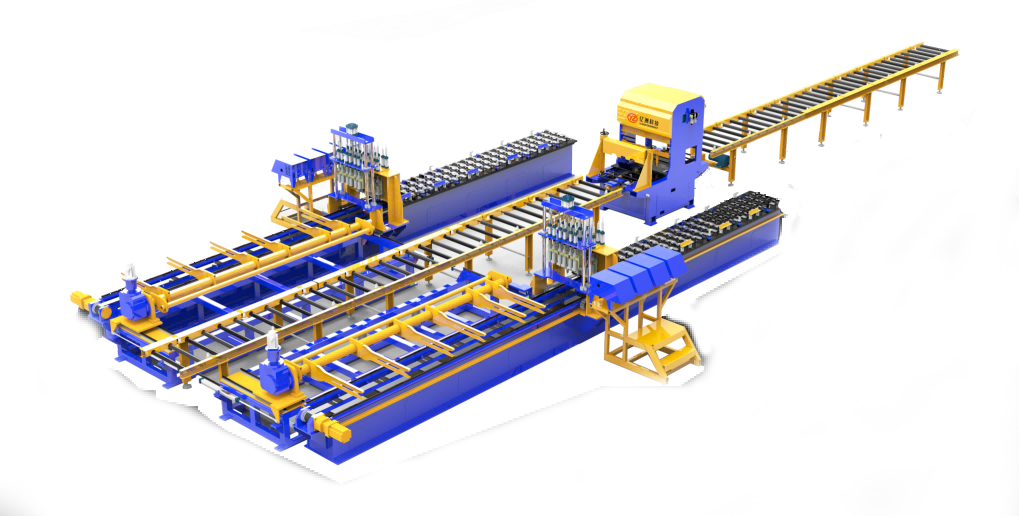
Look past the cycle-time claims and check how the line handles changeover. A productive line keeps the workpiece located from fit-up through welding without re-clamping, and it uses end stops or pins that repeat within half a millimeter. If the supplier cannot show you a time study for a similar truss profile with at least 70 percent arc-on time, walk away.
Modular makes sense only if you switch among at least four distinct chord geometries each week; otherwise the extra clamping points become unused cost and maintenance. Dedicated lines pay off when two or three high-volume profiles account for most of your output, because you can optimize head placement and drastically cut setup time.
For material over 8 mm, tandem or multi-wire submerged arc often gives the cleanest penetration with less spatter cleanup. For thinner webs and gussets, pulsed MIG with a synergic line keeps heat input controlled and reduces burn-through. Avoid forcing one process across every joint; a mixed-process cell usually beats a single-torch wonder.
Automate positioning, clamping, and repeatable weld starts first, because those remove the largest share of non-welding time. Full seam tracking and robotic adaptive fill add real value only when your incoming steel dimensions vary by more than 2 mm. If your material is consistent, basic mechanical guidance costs less and breaks down less often.
Ask the builder for a dry-cycle test with your actual truss CAD file, not their demo part. Record the time from loading raw chords to unloading a finished truss, then subtract 20 percent for interruptions, tip changes, and rework. That number, not the theoretical cycle time, is what you should use for capacity planning.
Foundation and anchoring can exceed the machine price if the floor is not flat within 5 mm over the line length. Consumables like contact tips, liners, and flux recovery filters add up quickly, especially with multi-arc setups. Also budget for spare servo drives and a service contract that covers onsite response within 48 hours, not just phone support.
Watch the changeover in person, not on video. A good flexible line uses quick-release pins, laser-etched position markers, and pre-set tooling carts so one operator can switch profiles in under 20 minutes. If you need a crane to move fixture blocks or the supplier tells you to just loosen everything and re-square it, you will lose hours every week.
Check that the line meets ISO 10218 or equivalent for robot cells, includes light curtains or area scanners at load stations, and has a hardwired e-stop that kills motion and welding power together. Ask for documentation on fume extraction airflow at each torch, and confirm the supplier will provide a CE or local conformity certificate, not just a component declaration.
Conclusion
A steel truss welding line rarely performs on the shop floor the way it does in a brochure. The first disappointments usually show up in material feeding and clamping: beams slip out of square, weld heads drift after a few hours, and the line needs constant manual babysitting. Throughput figures also deserve a hard look. Many quoted numbers come from short bursts with perfectly prepped stock, not from an eight-hour shift with imperfect saw cuts and occasional jams. Before trusting any spec sheet, match the machine's beam profile range and weld length capacity to the actual truss geometries you run, and check how deeply you can adjust voltage, wire feed, and travel speed for different joint types.
Maintenance is where the conversation gets quiet. Ask directly about consumable life, spare part lead times, and whether the vendor keeps critical components local. Automation should scale with your shop size: a small fabrication shop often gets more value from a semi-automatic line with manual loading than from a fully robotic cell that sits idle half the day. Larger operations, by contrast, can justify full automation through labor savings and repeatable weld quality. Before signing anything, run a short test list: weld your own beam profiles, run the line for at least one full shift, measure weld consistency across different lengths, and talk to current users about unscheduled downtime. The best line is the one that fits your real workload, not the one with the most impressive demo video.
Contact Us
Contact Person: Sophia Jiang
Email: [email protected]
Tel/WhatsApp: +86 17367381818
Website: https://yzwelding.com/