

OEM UHT Sterilizer Maker: Delivering Reliable Sterilization Solutions for Dairy Excellence
2026-07-24
In the competitive dairy industry, achieving perfect shelf life and safety starts with one critical step: sterilization. As an experienced OEM UHT sterilizer maker, INTOP Machinery engineers systems that preserve taste while eliminating pathogens—unlocking dairy excellence for brands worldwide. Discover how customized, reliable UHT solutions can transform your production line.
Crafting Precision: Inside Our UHT Sterilization Technology
Every drop that passes through our system is treated with an obsessive attention to thermal balance. We don’t just heat and cool—we choreograph a rapid, high-temperature dance that eliminates harmful microorganisms while locking in the product’s natural character. The process is tuned to preserve delicate flavors and nutrients, because safety should never come at the cost of what makes something worth drinking in the first place.
The core of our approach lies in holding the liquid at a precise temperature for mere seconds—long enough to ensure commercial sterility, short enough to avoid the flat, cooked taste that plagues lesser methods. Our engineers have refined the flow dynamics to eliminate hotspots and guarantee uniformity across every batch. It’s a discipline of milliseconds and microns, where even small deviations are treated as failures.
What sets our technology apart isn’t just the machinery, but the philosophy behind it. We measure success not by throughput alone, but by the sensory profile that survives the process. From dairy to plant-based alternatives, the result is a product that tastes freshly made, with a shelf life that reflects craftsmanship rather than compromise.
Tailored for Dairy: How We Customize Every Sterilizer
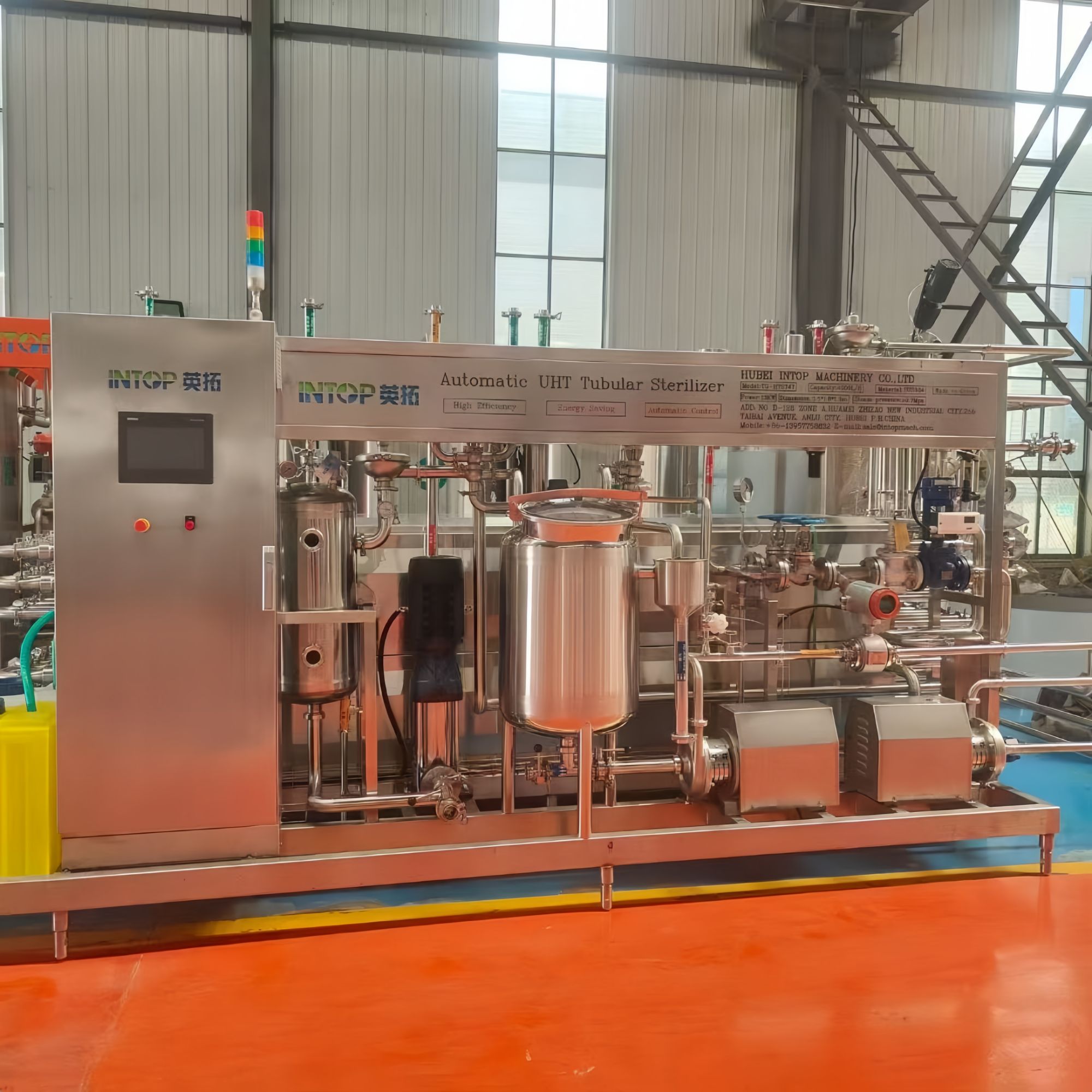
Dairy processing isn't one-size-fits-all, and neither are our sterilizers. We start by understanding the unique characteristics of your product—whether it's low-acid milk, viscous yogurt, or heat-sensitive cream—and map out the precise thermal profile needed to neutralize pathogens without compromising flavor or texture. Our engineers adapt everything from plate geometry and holding tube length to flow rates and temperature ramps, ensuring the sterilizer works in harmony with your existing line rather than forcing a generic solution.
Beyond the thermal cycle, we configure materials and controller logic to match your operational reality. High-polish stainless steel, EHEDG-compliant seals, and sloped drain lines are standard, but if you're running multiple recipes on the same line, we'll integrate recipe-driven automation that adjusts parameters in minutes without manual recalibration. Need CIP integration that handles residual milk fat differently from cleaning an acid whey stream? We'll design a dedicated spray ball alignment and chemical dosing sequence that cuts downtime and water consumption by double digits—because a sterilizer shouldn't just work for your product on day one, it should keep working efficiently as your portfolio evolves.
Built to Last: The Materials and Engineering Behind Reliability
Durability isn't achieved by chance — it's designed into every weld, rivet, and grain of material. The marriage of high‑strength alloys with fatigue‑resistant composites underpins systems that endure decades of relentless stress. Advanced metallurgy, from vacuum‑arc‑remelted steels to single‑crystal turbine blades, pushes back against creep, corrosion, and crack propagation. Meanwhile, elastomeric seals formulated with proprietary carbon‑nanotube blends maintain integrity through brutal thermal swings that would shred ordinary polymers.
Behind the material choices lies a layer of engineering known as damage tolerance. Structures are deliberately built with redundant load paths and crack‑arrest features, ensuring that a small flaw doesn't cascade into catastrophic failure. Finite element models, validated by decades of strain‑gauge data from operational fleets, allow engineers to predict exactly where fatigue will strike first — and then reinforce those spots before they ever see service. This predictive mindset transforms maintenance from reactive guesswork into a precise, data‑driven practice.
What truly separates reliable engineering from the merely adequate is a philosophy of “graceful degradation.” Rather than aiming for an impossible zero‑defect ideal, designers bake in controlled failure modes: a bearing that gets noisier as it wears, a structural member that visibly yields long before it snaps. By giving operators clear, early warnings, these systems sidestep sudden breakdowns entirely. That quiet interplay of specialized materials and shrewd engineering is why some machines rack up millions of cycles while others are forgotten after their first overhaul.
Seamless Integration: Optimizing Your Production Line Without Disruption
When upgrading a production line, the fear of downtime often holds manufacturers back. The reality is that even brief stoppages can cascade into missed deadlines and eroded margins. However, a seamless integration strategy turns this on its head—new equipment and systems can be woven into existing workflows with barely a ripple. The key lies in meticulous pre-planning and selecting partners who understand the operational rhythms of your facility.
Modern integration relies on modular automation and plug-and-produce architectures. Instead of a full-scale rip-and-replace, we deploy new stations in parallel, validating them offline before synchronized cutover during naturally occurring pauses. This incremental approach distributes risk and lets your team adjust at a comfortable pace. It's less about a dramatic switch and more about careful choreography—timing each step to match production cadences so that by the time you're fully up to speed, the old and new have already merged imperceptibly.
Adaptive control systems further safeguard continuity. Intelligent sensors and edge devices monitor line balance in real time, dynamically tweaking parameters to absorb variances introduced by new modules. The result? Output never dips, quality remains consistent, and operators experience a smooth transition rather than a jarring overhaul. It's integration that respects the existing ecosystem while quietly elevating it, delivering optimization without ever pressing pause.
From Concept to Completion: Our End-to-End Partnership Approach
Every project begins with a conversation, not a checklist. We sit down with your team to understand not just what you want to build, but why it matters. From the first whiteboard sketch to final deployment, we stay embedded in your vision—collaborating on architecture, questioning assumptions, and shaping solutions that genuinely reflect your goals. There’s no handoff to a mysterious “technical team”; you work with the same people who helped you define the idea.
As the build progresses, we keep things transparent and adaptive. Weekly check-ins aren’t about status reports—they’re working sessions where we demo real features, gather feedback, and pivot without penalty. When unexpected roadblocks appear, we problem-solve together. This tight feedback loop means the final product rarely surprises anyone; it feels like a natural extension of the conversations that started it all.
After launch, we don’t vanish. We stick around to monitor performance, train your team, and refine based on actual usage data. Whether it’s a minor tweak or an ambitious new phase, the same close partnership carries forward. Completion, for us, isn’t a finish line—it’s just the point where our collaboration enters its next chapter.
Real-World Performance: Case Studies in Dairy Excellence
When we look beyond controlled trials and into the everyday rhythms of working farms, the concept of performance takes on a much richer meaning. It’s no longer just about a single metric on a spreadsheet—it becomes a story of consistency, resilience, and incremental gains that add up over time. On one Wisconsin operation, for instance, a shift to more frequent ration adjustments based on real-time forage analysis didn’t produce a dramatic overnight spike in production. Instead, it smoothed out the dips that used to occur between cuttings, keeping milk components steady and cows content. The herd’s average stayed within a remarkably narrow band month after month, which meant fewer metabolic hiccups and a more predictable paycheck. What they’d achieved wasn’t glamorous, but it was sustainable—and that’s exactly the kind of performance that keeps a dairy thriving through volatile markets.
In another corner of the dairy world, a New Zealand grazing system demonstrated that performance often hides in plain sight. They focused on something almost old-fashioned: walking the paddocks every day, not just to check grass cover but to observe cow behavior. Subtle cues—how quickly cows laid down after milking, the shine on their coats, the vigor of their cud chewing—became their leading indicators. When those signals slipped, they didn’t wait for bulk tank readings to confirm a problem. They’d adjust rotation speed or offer a fiber supplement before a drop in production ever materialized. Over the course of a season, this proactive approach trimmed days off the calving interval and boosted lifetime milk solids per cow. There were no high-tech gadgets involved, just a disciplined commitment to reading the herd. It’s a reminder that performance is often the result of paying attention to the things that don’t make it into the official reports.
Then there’s the quiet revolution underway in heat stress management. A large-scale dairy in central California moved away from the typical one-size-fits-all cooling protocol and started customizing sequences based on time of day, humidity, and even group dynamics. The change didn’t come from a research paper—it came from one manager’s habit of standing in the holding pen at 3 p.m. in August, noticing which cows were panting even with fans and sprinklers running. By staggering misting intervals and adding targeted shade structures, they drove down respiration rates and saw conception rates inch up during the toughest months. More importantly, the crew noticed fewer cows hanging back in the parlor during peak heat, a small shift that spoke volumes about cow comfort. Those kinds of gains don’t always scream for attention, but over time they carve out a competitive edge that separates a good year from a great one.
FAQ
UHT stands for ultra-high temperature. It rapidly heats milk or other dairy to around 135–140°C for a few seconds, wiping out harmful bacteria while keeping the taste and nutrients mostly intact. That’s how you get shelf-stable milk that doesn’t need refrigeration until you open it.
Off-the-shelf machines force you to adapt your process to the equipment. An OEM partner builds the sterilizer around your production line, your bottle sizes, your throughput targets. You’re not just buying a machine—you’re getting a system designed to mesh with what you already do.
Milk is the obvious one, but we also design for flavored milks, creams, yogurts, custards, even plant-based dairy alternatives. If it’s liquid or semi-liquid and needs long shelf life, we can likely build a line for it. Viscosity, particulates, sugar content—those all factor into the engineering.
We build in redundancy and real-time monitoring. Temperature probes, flow sensors, and pressure checks are constantly feeding data back. If anything drifts outside the tight parameters, the system either self-corrects or shuts down safely. Plus, our heat exchanger designs minimise hot spots and dead zones where bacteria could survive.
Flavour damage mostly comes from over-processing. We use precise, short-duration heating and rapid cooling profiles. The heat exchangers are engineered for uniform thermal transfer, so you don’t get those cooked or burnt notes. Customers regularly tell us their UHT milk tastes closer to fresh pasteurised than typical shelf-stable products.
You’re not left alone once the machine is bolted down. We do on-site commissioning, train your operators, and then stay reachable for troubleshooting. Most dairies keep a remote diagnostic link with us, so our engineers can often spot issues before you even notice a problem. Spare parts are stocked regionally to avoid long downtimes.
We have modular designs that scale down without sacrificing the core technology. A small artisan dairy making premium shelf-stable cream is just as focused on quality as a big player. We tailor the footprint and capacity, and because we’re OEM, we can often integrate with lower-cost peripheral equipment you might already own.
Conclusion
我们生产的每台UHT灭菌器都始于对精密工程的理解。灭菌技术并非一刀切,而是针对乳制品加工的特性精心调校,从热交换效率到流速控制,确保牛奶、奶油或酸奶饮料保持其风味和营养。通过与客户紧密合作,我们将设备设计成您生产环境的自然延伸,无论是紧凑的空间还是高产能线,都能无缝适配。使用的材料——从耐腐蚀合金到高级密封件——经过严格挑选,不仅为了抵御高温和酸碱清洗,更是为了在数十年不间断运行中保持性能稳定。
从最初的概念讨论到最后的安装调试,我们始终陪伴左右,确保每个阶段都透明、高效。我们的工程师深入了解您的现有流程,使得新灭菌器能够毫无中断地并入生产线,甚至常常提升整体效率。这种协作已在全球多家乳品厂得到验证:连续运行的稳定性、更低的维护需求以及对产品一致性的显著改善,共同转化为商业上的卓越。我们追求的不是单纯销售设备,而是成为您乳品品质长期可靠的基石。
Contact Us
Contact Person: Laura
Email: [email protected]
Tel/WhatsApp: +86 13957758832
Website: https://www.intopmachinery.com