

Thoracic Aortic Stent Graft Systems: Which One Is Reliable?
2026-10-18
When a thoracic aortic aneurysm or dissection demands endovascular repair, the device choice is anything but trivial. Too many stent graft systems enter the market with impressive bench tests but limited real-world follow-up. Reliability means more than just staying in place—it means predictable deployment, low endoleak rates, and durability across diverse anatomies. That’s why a growing number of vascular teams are looking closely at INT, a developer whose thoracic aortic stent graft has drawn attention for its controlled delivery and robust clinical data. But is it the most reliable option available? In the sections ahead, we break down what actually matters when comparing these life-saving devices.
What 'Reliable' Actually Means for a Thoracic Stent Graft
For most devices, "reliable" gets boiled down to "won't break." A thoracic stent graft has to do far more than avoid catastrophic failure. It lives in a high-pressure, constantly moving environment where every heartbeat flexes the fabric and metal. True reliability means the graft maintains its structural integrity year after year without fatigue fractures, suture line failures, or fabric wear that could silently compromise the repair.
Beyond material durability, a trustworthy stent graft must stay exactly where it was deployed. Migration, infolding, or loss of seal at the proximal landing zone can turn a successful procedure into a delayed complication. Reliability here is about predictable radial force and conformability that respects the tortuous anatomy of the aortic arch without sacrificing fixation.
Ultimately, the word only earns its meaning through long-term clinical data across diverse patient anatomies. A graft that performs well in a straight segment may struggle in a sharply angulated arch. Reliable performance is not a label on the box—it is the accumulated evidence that the device holds up, stays put, and keeps sealing in real patients over many years.
A Field Guide to Current Device Categories
Trying to sort today's gadgets into tidy buckets feels a bit like herding cats through a laser maze. The old labels—phone, computer, camera—barely hold up when a single pocket slab can be all three and then some. What we call a "tablet" might run the same operating system as a desktop, while a "smart speaker" sits quietly as the hub for a dozen other things you never see. The real division isn't about size or brand; it's about how a device invites you to interact with it, and what it quietly takes off your plate.
Look closer and the categories blur by intention. You have your screen-first companions: phones that have swallowed music players, maps, and wallets whole. Then there are the wearables, which trade screen real estate for constant, low-friction presence on your wrist or face. Home devices split further—some are meant to be touched (a thermostat, a light switch), others are meant to be talked to from across the room. And underneath all of it, a growing class of "ambient" gear: sensors, plugs, and tiny modules that do their jobs without ever asking for your attention. The guide isn't about listing specs; it's about noticing which devices demand your eyes, your voice, or nothing at all.
What trips people up is assuming categories stay fixed. A gaming handheld from a decade ago now looks almost quaint next to a phone that can stream console titles. A fitness tracker morphs into a health monitor without changing its name. Instead of obsessing over what a device is called, the useful move is to ask: Where does it live in your day? Does it require both hands, one thumb, or just a glance? Answer those, and the category names stop mattering so much—you'll know exactly what kind of tool you're dealing with.
Pivotal Trials Versus Daily Practice: Where the Truth Lives
The gap between a pivotal trial and the daily clinic is where medicine often feels like a guessing game. Trial protocols hand-pick patients, strip away real-world chaos, and follow every dose to the minute. But the patient in front of you on a Tuesday afternoon rarely matches that clean profile. She has three comorbidities, takes six other medications, and forgot her pill yesterday. The truth about a treatment isn't found in the abstract—it's found in the messy, unfiltered reality of everyday care.
Pivotal trials answer a narrow question under near-perfect conditions. Daily practice asks a broader one: does this work for my patient, right now, with all her imperfections? Efficacy and effectiveness are not synonyms. A drug that shines in a controlled study may stumble when adherence slips, when follow-up is patchy, or when the patient population is older and sicker than the trial cohort. The real truth lives in that friction—between what was shown to work and what actually happens when no one is watching.
That doesn't make trials useless; it makes them a starting point, not the finish line. The most honest clinicians learn to read both layers: the trial gives you a signal, the daily practice gives you the noise. And in that noise, patterns emerge that no registration study could ever capture. So the next time someone quotes a landmark trial, ask what happened after the last patient visit. That's where the truth quietly lives.
The Hidden Engineering Behind Graft Fabric and Stent Rings
Graft fabric rarely draws attention, yet its weaving pattern is far from arbitrary. The yarn density, crimp amplitude, and pore size are tuned so the textile remains blood-tight during implantation while still allowing macrophages and fibroblasts to infiltrate over the following weeks. Weavers run the looms with tight tension control because a small drift in filament feed changes the fabric's radial compliance just enough to cause a wrinkle inside the lumen.
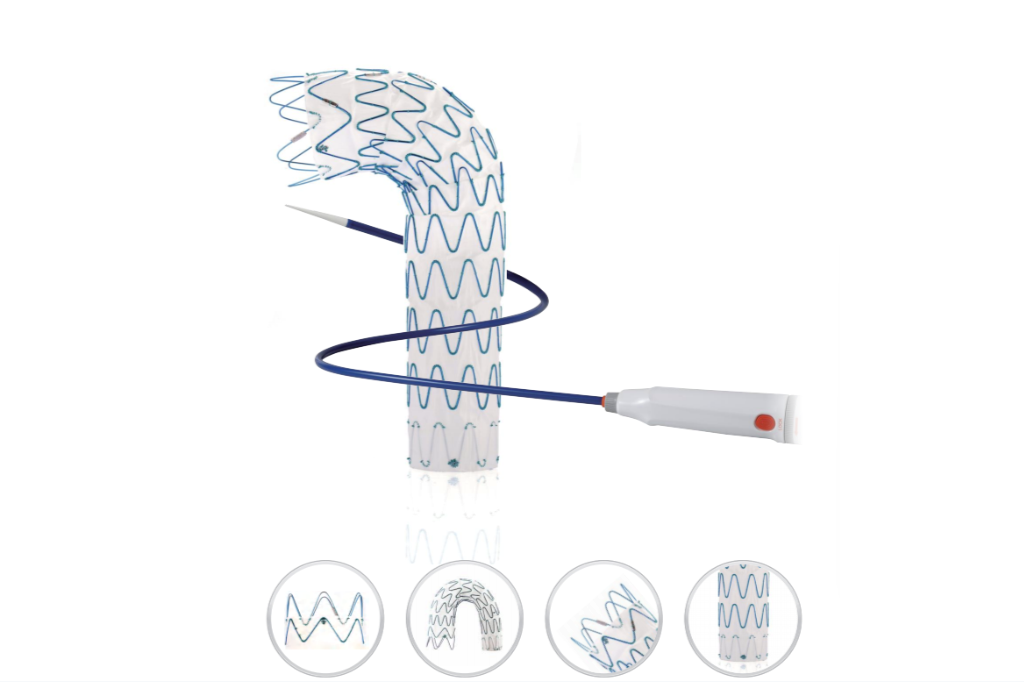
Stent rings often look like plain zigzag wires, but their amplitude, strut width, and apex angle are varied along the graft's length. Near the proximal sealing zone, the rings deliver higher radial force to pin the device against the aortic wall, while distal rings are softened to avoid erosion into thinner iliac arteries. The nitinol is usually heat-set so its austenite finish temperature sits a few degrees below body heat, letting the rings expand with deliberate force instead of a sudden snap.
Where the fabric meets each ring, a predictable failure point, engineers use a locking stitch that shifts load away from single suture holes. Radiopaque markers are crimped or braided in at known intervals, giving the surgeon a clear view of graft orientation without adding stiff metal segments that would disturb the fabric's conformity.
Anatomy Trumps Brand: Matching Device to Patient
A patient's unique anatomical structure should always guide device selection far more than any brand loyalty or marketing influence. Two individuals with the same diagnosis can present with vastly different internal dimensions, tissue characteristics, or vascular pathways. A device that performs flawlessly in one body may be uncomfortable, ineffective, or even dangerous in another, regardless of how reputable its manufacturer is. Clinicians who prioritize anatomy over brand recognize that the goal is not to fit the patient to a product, but to find the product that fits the patient.
Consider common scenarios such as choosing a central venous catheter, an orthopedic implant, or a noninvasive ventilation mask. Each requires careful measurement of patient-specific landmarks: vein diameter and depth, bone geometry and density, or facial contours and nasal bridge height. Brand catalogs may offer dozens of options, but none can override what the anatomy clearly dictates. Taking the time to assess and measure before reaching for a familiar brand reduces the likelihood of pressure injuries, thrombosis, malposition, or poor functional outcomes. It shifts the decision from habit to evidence, placing the patient's body at the center of the process.
This approach does demand more clinical effort and a deeper understanding of available device portfolios. Yet it consistently delivers safer care and higher long-term satisfaction. When a device matches the patient's anatomy precisely, recovery tends to be smoother and complications fewer. The strongest brands earn trust by offering a wide enough range of designs to accommodate real anatomical diversity, not by convincing clinicians to ignore what they see in front of them. In the end, anatomy holds the final vote, and every brand must adapt to that reality.
When Things Go Wrong: Lessons From Explant and Reintervention Data
Explant and reintervention records do not flatter a device; they expose it. When a surgeon removes an implant or returns to fix what should have healed, the reasons recorded in operative notes and registry forms become a brutally honest ledger of design assumptions meeting biology. Infection, loosening, late fracture, wear debris, and misalignment show up not as theoretical risks but as recurring events with patient initials and dates attached.
The most useful lessons come from clustering these failures rather than treating each as an isolated mishap. A pattern of early reintervention after a change in surface coating, for instance, can reveal a problem long before randomized trials would. Explant analysis adds another layer: retrieved components carry physical evidence of motion, corrosion, or tissue reaction that no imaging study can capture. This feedback loop, when taken seriously, shortens the distance between a flawed version and a safer one.
FAQ
The difference often comes down to fabric-to-stent attachment durability, modular junction design, and how the device handles continuous cyclic loading from the aorta. Grafts with reinforced seams, low-profile modular connections, and controlled suture lines tend to show fewer late failures in registry data, but operator deployment technique still matters more than most people admit.
Reliability isn't just freedom from endoleak; it includes predictable deployment, stable fixation without bird-beaking, resistance to migration under high-flow conditions, and long-term material integrity. A device can have excellent early sealing but still be unreliable if it fractures at the stent apices after five years.
It depends on the specific platform. Grafts with enhanced conformability and pre-curved designs handle arch curvature more reliably, while stiffer devices may seal well in the relatively straight descending segment but struggle with proximal angulation. Matching device architecture to the landing zone is more critical than picking a "best" brand.
Extremely important. A device that deploys even 5 mm off target can compromise the seal, lead to type Ia endoleak, or cause unintentional coverage of arch branches. Delivery systems with staged deployment, gentle tip retraction, and controlled release tend to produce more reproducible results, which translates directly into fewer secondary interventions.
Nitinol's superelasticity and shape memory give it an advantage in conforming to pulsatile aortic motion, but the fatigue life depends heavily on stent design, surface finishing, and the number of cell rows. High-quality electropolished nitinol stents with fewer sharp bends and smooth transitions tend to resist fracture better than stainless steel in the thoracic aorta.
Not yet across the board. Custom fenestrated and branched systems can solve complex arch anatomy, but they introduce additional modular connections, target vessel bridging stents, and longer procedure times. Their reliability is improving, but long-term data still lag behind simpler tubular thoracic grafts, especially for arch branch patency.
Look beyond the company's marketing summary. Examine independently published mid-term outcomes, rates of type I and III endoleaks, all-cause reintervention, and device-related adverse events in similar anatomy. Also check the instructions for use regarding oversizing limits, as pushing those limits is a common cause of apparent device failure.
Conclusion
Reliability in a thoracic aortic stent graft is never a single specification; it is the accumulated result of fabric durability, ring fatigue resistance, deployment precision, and long-term freedom from type I and III endoleaks. Current systems divide loosely into polyester grafts on stainless steel or nitinol skeletons, some with proximal bare springs and others with covered flanges, and these design choices quietly determine how a device behaves in a hostile aorta. Pivotal trials give a clean but narrow view because they enroll favorable anatomy, whereas daily practice throws in tortuous arches, reverse-taper necks, and shaggy aortas. Registry and explant data therefore carry the real signal: a device that looks excellent under trial conditions can underperform when forced into anatomy it was never tested for.
What often escapes attention is the hidden engineering—fabric weave density, suture patterns, and ring spacing—that dictates how the graft absorbs cyclic strain without fatiguing or wearing through. Yet anatomy consistently trumps brand allegiance. A graft that seals perfectly in a straight distal arch may fail in a short, angulated landing zone or a heavily calcified neck, regardless of the manufacturer’s claims. Reintervention and explant analyses point to the same conclusion: most failures stem from patient-device mismatch, not from an intrinsically defective system. The truly reliable thoracic stent graft, then, is not the most famous or the newest; it is the one chosen after meticulous sizing, careful assessment of the supra-aortic branches, and honest acknowledgment of each device’s mechanical limits.
Contact Us
Contact Person: Jeffrey
Email: [email protected]
Tel/WhatsApp: 86-0633-2230056
Website: https://www.sd-intmedical.com