

Wholesale ADA Sign Material from China: Your Guide to Compliant, High-Quality Signage Supplies
2026-09-04
Finding ADA sign material that holds up under inspection, UV exposure, and daily wear is harder than it should be. Many shops burn cash on cheap imports that fail compliance checks. That's why we're breaking down what actually matters when sourcing wholesale ADA sign material from China—and why LYSHIRE has become a go-to for compliant, high-quality signage supplies. Whether you're scaling production or refining a single project, this guide gives you the clear-eyed criteria to buy with confidence.
Decoding ADA Sign Rules Without the Legal Headache
Forget flipping through dense federal code. The ADA sign requirements mostly boil down to a handful of repeatable specs: non-glare backgrounds, proper character contrast, tactile lettering, and mounting zones. Once you strip away the legalese, it reads more like a punch list than a law review article.
A common trap is assuming every sign needs braille. That's not the case. Room identification signs—like restrooms, stairwells, or numbered offices—must have Grade 2 braille and raised characters, but directional, informational, and temporary signs usually don't. Knowing which category your sign falls into removes half the guesswork.
Placement trips up more projects than design. The tactile characters need to sit between 48 and 60 inches above the finished floor, measured to the baseline. And if the door swings toward you, the sign belongs on the latch side. Get those two details right, and you've already handled the toughest part of the inspection.
What Actually Makes a Sign Material Last in Public Spaces
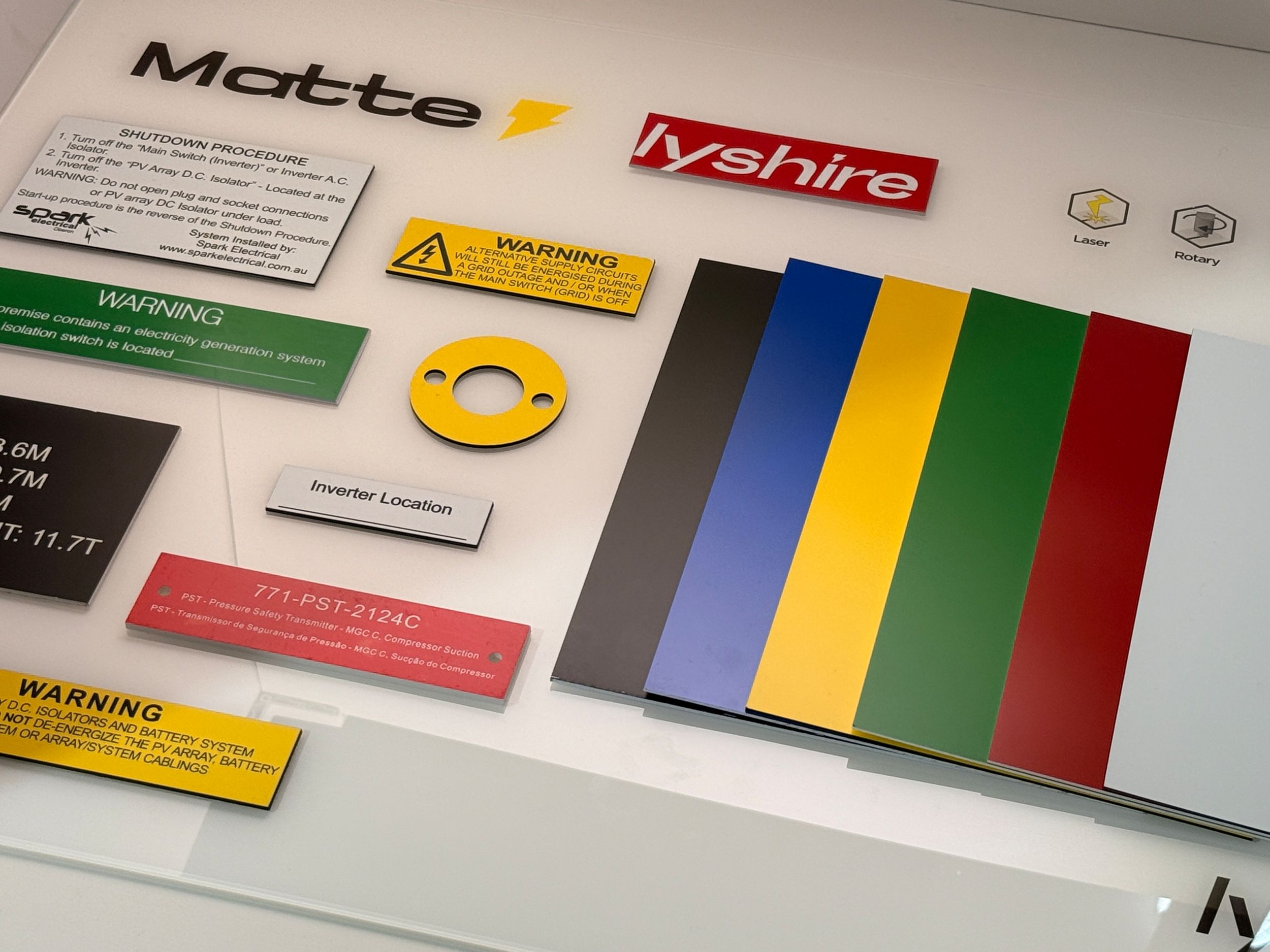
The lifespan of a sign in a public space rarely comes down to a single material property. It is the quiet interplay between surface chemistry, fabrication method, and the specific microclimate of the installation site that decides whether a sign fades in two years or remains legible after a decade. A powder-coated aluminum panel might perform beautifully in a shaded courtyard, yet the same panel mounted near a busy roadway can develop edge corrosion from constant vibration and salt spray. Understanding this context first is what separates a durable choice from a costly assumption.
Most premature failures trace back to three overlooked stress points: UV degradation of the color layer, thermal expansion cycles that crack rigid substrates, and moisture ingress along unfinished edges. Rather than chasing the highest advertised warranty, it often pays to inspect how the material behaves at its joints and cut ends. For example, a high-pressure laminate may keep its face color for years, but if the core is exposed at a routed edge and not sealed, water will find a way in and slowly delaminate the sign from the inside out.
Then there is the issue of maintenance reality. A material that requires specialized cleaning agents or annual resealing tends to fall apart in municipal budgets where upkeep is sporadic. Signs that last are usually the ones whose material simply tolerates neglect: anodized aluminum, properly sealed fiber cement, or cast acrylic with UV-stable inks. They do not demand heroics. They just sit there, taking the sun, the rain, and the occasional graffiti attempt, and they keep doing their job long after the cheaper alternatives have been replaced twice.
Chinese Suppliers That Prioritize Precision Over Mass Production
In China's manufacturing landscape, a quiet shift has been underway for years. A growing number of workshops in Shenzhen, Dongguan, and Suzhou no longer chase ten-thousand-unit contracts. Instead, they invest in five-axis machining centers, coordinate measuring machines, and engineers who treat a 0.005 mm deviation as a personal failure. These suppliers serve medical device startups, satellite component buyers, and robotics firms that cannot afford a single out-of-spec part.
What sets them apart is not just equipment but mindset. A precision-first shop will stop a production run to recalibrate a tool rather than push through questionable pieces. They often hold ISO 13485 or AS9100 certifications, but the real test is how they handle a first article inspection report. You'll find that their quotes include metrology reports, not just a unit price. They are comfortable with batches of fifty or even five, because their margins come from skill, not throughput.
Working with these suppliers requires a different approach. Instead of asking "what's your MOQ?", ask "can you hold ±0.01 mm on this titanium bracket across 200 pieces?" The best ones will ask about your application, suggest a better material or finish, and send you a CMM report before you ask. That kind of dialogue is how you separate a precision partner from a volume vendor.
Choosing Substrates That Balance Cost, Weight, and Durability
Finding the right substrate often starts with a simple reality check: what can you afford without compromising the lifespan of the product? Cheaper materials like standard MDF or basic plywood may keep initial costs low, but they often add unnecessary weight or fail under repeated stress. A more practical route is to compare not just the price per sheet, but the cost per year of service. For instance, a slightly more expensive high-density fiberboard can last twice as long as standard MDF while weighing nearly the same, making it the better long-term investment.
Weight is another factor that sneaks into the equation through shipping, handling, and installation. A panel that is lightweight might seem attractive until it flexes under load or dents easily. Conversely, an ultra-durable option like solid hardwood may be overkill if the application only needs moderate wear resistance. Look for engineered substrates such as aluminum composite panels or PVC foam boards. These materials offer a good stiffness-to-weight ratio, cutting down on freight costs without sacrificing the structural integrity that daily use demands.
Durability, however, is rarely a single attribute. It includes resistance to moisture, impact, UV exposure, and temperature swings. A substrate that works perfectly indoors may warp or fade outdoors within months. The trick is to list the specific stresses your project will face and then choose a material that meets those needs without adding unnecessary cost or weight. For example, a cement-bonded particle board handles moisture well and is moderately priced, but it is heavy. If your design tolerates some extra weight, that trade-off may be worthwhile. The goal is to strike a balance that makes sense for your unique application, not to chase a one-size-fits-all solution.
The Hidden Logistics That Protect Bulk Sign Orders
When a company places a bulk order for signs, the visible craftsmanship often overshadows the behind-the-scenes coordination that keeps everything intact. From the moment pallets leave the production floor, a quiet network of logistics steps in—custom crating, vibration-dampening inserts, and moisture barriers are just the beginning. Each shipment is mapped against regional weather patterns and carrier reliability scores, ensuring that hundreds of identical panels arrive without a single scratched corner or warped edge.
Beyond physical protection, real-time tracking protocols operate with unusual precision for non-perishable goods. Every pallet receives a unique digital twin that logs temperature fluctuations, tilt events, and even sudden stops during transit. If a truck idles too long in high humidity, the system automatically flags the batch for inspection before final delivery. This layer of oversight transforms what could be a chaotic freight run into a choreographed sequence where risks are predicted and neutralized before they reach the customer's dock.
The final mile often hides the most intricate safeguards. Drivers assigned to bulk sign deliveries are trained in proper unloading sequences to prevent edge damage, and many logistics providers position regional redistribution hubs specifically to shorten the distance from warehouse to storefront. For the buyer, the signs simply appear on schedule, but for those managing the hidden logistics, every order is a test of how silently a system can absorb shocks, reroute around delays, and preserve a perfectly uniform visual product.
Simple Checks to Ensure Your Order Meets ADA Standards
Before you finalize any purchase, take a moment to look at the product dimensions and clearance requirements listed on the page. Many ADA compliance issues start with a doorway that's an inch too narrow or a turning radius that doesn't quite work. Grab a tape measure and check those numbers against the actual space where the item will live — it's a habit that saves you from costly returns and frustrating installs.
Next, verify that the controls and operable parts don't require tight grasping, pinching, or twisting of the wrist. A good rule of thumb is to see if you can operate them with a closed fist or an open palm. If the spec sheet only mentions a knob or a pull without further detail, reach out to the manufacturer for a force test or a demo video. You'd be surprised how often a simple lever swap can bring a product into full compliance.
Finally, don't skip the installation checklist. Even a fully compliant product can fail in practice if it's mounted at the wrong height or set back too far from the wall. Print out the ADA reach range and mounting height chart, keep it next to your level and drill, and double-check each measurement before you anchor anything. This extra ten minutes on the front end makes the difference between a smooth inspection and a redo.
FAQ
ADA-compliant materials need to meet specific tactile and visual requirements: raised characters between 1/32 and 1/8 inch, non-glare finish, and a minimum 70% contrast between text and background. Using the wrong stock—like glossy acrylic or thin vinyl—can fail inspection and force a redo, which is costly on commercial jobs.
Chinese manufacturers often offer a wider range of substrate options—acrylic, photopolymer, brushed metal, and wood-look laminates—at prices that let you keep margins healthy on larger projects. The key is working with a supplier that understands ADA specs and can provide material data sheets, not just samples.
The workhorses are 1/8-inch acrylic for interior signs, photopolymer for detailed tactile lettering, and stainless steel or aluminum for high-traffic or exterior applications. Ask about UV stability if signs will see sunlight, and always request a physical swatch to check color contrast and texture.
Ask for third-party test reports or material certifications that reference the 2010 ADA Standards for Accessible Design, specifically sections 703.2 through 703.4. A trustworthy supplier will also send you a pre-production sample with raised lettering you can feel and measure. If they hesitate on documentation, move on.
Beyond standard sizes and colors, look for suppliers that can do CNC routing, laser engraving, or direct digital printing on the substrate. Some offer pre-assembled tactile text applied to the face, which saves you fabrication time. Clarify whether you're buying raw sheets, cut blanks, or finished signs—the pricing and minimums differ significantly.
MOQs vary by material and finish. Acrylic sheets might start at 50 or 100 pieces, while custom photopolymer runs often require 200 or more. Smaller suppliers may be flexible if you pay a setup fee, so it's worth negotiating if you have a pilot project or need samples for a client presentation.
Start with a paid sample order before committing to a container load. Check the sample for thickness consistency, edge smoothness, and color accuracy under different lighting. Then request a pre-shipment inspection report with photos of random pieces from your lot. Many Chinese suppliers will include this at no extra cost for wholesale orders.
Yes—factor in sea freight, customs duties, and possible tariffs on fabricated metal or acrylic goods. Lead times commonly run 3 to 6 weeks production plus 2 to 4 weeks shipping, so order well before your project deadline. Ask for Incoterms like FOB or DDP so you know exactly where responsibility and costs shift.
Conclusion
Navigating federal signage requirements doesn't have to mean hiring a compliance attorney. The core of ADA sign rules boils down to tactile lettering, non-glare finishes, proper contrast, and mounting heights—details that reputable manufacturers embed into their standard production runs. What separates a sign that lasts a decade from one that fades or warps in two years is the substrate. Public spaces punish materials with UV exposure, cleaning chemicals, and constant handling, so acrylic, photopolymer, and high-pressure laminate have become go-to choices for their scratch resistance and color stability. Chinese suppliers who focus on precision rather than raw output often run tighter tolerance checks on raised characters and Braille dot spacing, which translates directly into fewer rejected shipments for buyers.
Cost, weight, and durability rarely align by accident. Thinner acrylic or composite panels cut shipping weight and expense, but they sacrifice impact resistance in high-traffic corridors; a layered approach—using a rigid core with a resilient face—often delivers the best middle ground for bulk orders. Too many buyers overlook the logistics that happen after the pallets leave the factory: moisture-sealed wrapping, edge protectors, and labeled inner cartons prevent the kinds of scratches and warping that turn a profitable order into a loss. Before signing off on a purchase order, run your own simple checks. Request a physical sample to test tactile contrast under real lighting, verify that Braille domes are uniformly rounded, and confirm the supplier's dimensional tolerances against the latest ADA Standards for Accessible Design. These steps take minutes but eliminate the most common compliance failures that surface only after installation.
Contact Us
Contact Person: Tina Hou
Email: [email protected]
Tel/WhatsApp: +86 17816238685
Website: https://www.lyshire.com